




Brevard County’s vacant land market shows a highly stratified pricing landscape influenced by zoning, parcel size, and the range between raw rural acreage and build-ready residential lots. After rapid pandemic-era appreciation, with some Florida metros seeing price-per-acre spikes over 270%, valuations have stabilized, dropping 0.35% statewide year-over-year.
Price-per-Acre Valuations in Brevard County
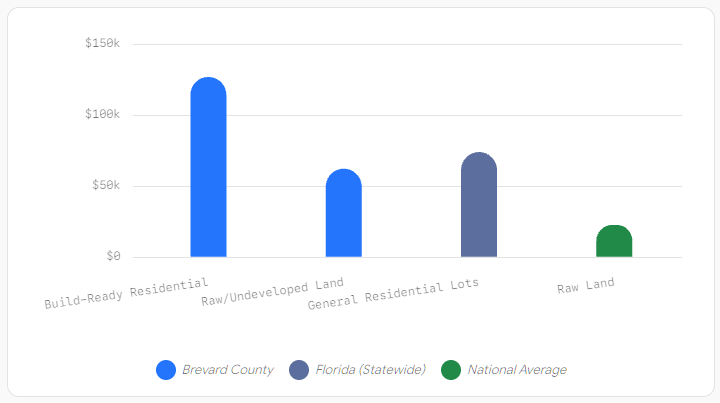
Florida’s statewide median for residential vacant land currently sits at $74,000 per acre, with Central Florida submarkets generally ranging between $50,000 and $100,000 per acre. However, Brevard County commands a distinct premium for buildable residential space. Recent recorded sales data indicates the median price per acre for Brevard residential vacant land reached $126,795, with upper-range parcels exceeding $217,300 per acre.
When analyzing broader undeveloped land, including larger tracts in South Brevard and rural unentitled acreage, valuation metrics adjust significantly. The median price per acre for general undeveloped land in Brevard County is about $62,260, with land listings averaging 43 acres.
The Impact of Development Status
The stark contrast between a $126,000 residential acre and a $62,000 rural acre is driven by entitlement, clearing, and utility access costs. National data shows how development status dictates land value:
- Build-Ready Land: $126,071 median price per acre
- Realtor.com
- Partially Developed Land: $53,530 median price per acre
- Realtor.com
- Raw Land: $22,682 median price per acre
- Realtor.com
In South Brevard, buyers seeking raw land for agricultural, recreational, or future speculative use can find parcels near the $62,000-per-acre threshold. Buyers looking at smaller, platted lots face higher per-acre prices. As of October 2026, the median list price for an individual lot in Brevard County remained $47,000.
Market inventory for undeveloped land remains robust. Brevard County holds over 560 undeveloped properties totaling more than 730 acres, providing sufficient liquidity for investors evaluating South Brevard’s rural expansion corridors.
What are the zoning regulations and setback requirements for building on vacant land in South Brevard County?
Zoning and setback regulations for vacant land in South Brevard County are determined by the specific zoning district, with requirements scaling based on lot size, intended use, and environmental factors.
Standard Single-Family Residential (e.g., Palm Bay RS-1, RS-2, RS-3)
- Front Setback: 25 feet.
- Rear Setback: 20 feet.
- Side Setback: 7.5 feet on each side.
- Corner Lots: Exposed to two streets, these lots require 25-foot setbacks on both street-facing sides, a 25-foot rear setback, and a 7.5-foot setback on the interior non-street side.
- Building Limits: Residential structures are typically limited to 35 feet in height, and the maximum lot coverage for the dwelling and accessory structures is capped at 40%.
Rural and Agricultural Land
- Farm Residential (F-R): Generally requires a minimum of one acre, with setbacks of 30 feet in the front, 25 feet in the rear, and 10 feet on the sides. Larger FR-2 and FR-2.5 districts (two and 2.5 acres, respectively) increase front and rear setbacks to 50 feet, with 25-foot side setbacks.
- General Agriculture (A-2): Typically requires five acres and dictates a 50-foot front setback, 40-foot rear setback, and 25-foot side setback.
- Agriculture/Conservation (A-1): Requires 20 acres and enforces strict 50-foot setbacks across the front, rear, and sides.
Environmental and Waterbody Modifiers
- Waterfronts: Habitable structures near Class III water bodies require a 30-foot setback from the ordinary high water level.
- Coastal Properties: Must adhere to a 25-foot coastal construction setback line.
- Sensitive Lands: Residential development adjacent to environmentally sensitive land generally mandates a 50-foot environmental setback.
- Floodplains: Properties in flood-prone areas must meet additional county floodplain requirements and minimum floor elevations, often requiring habitable space to be at least 24 inches above the reference plane.
Check out this article next