





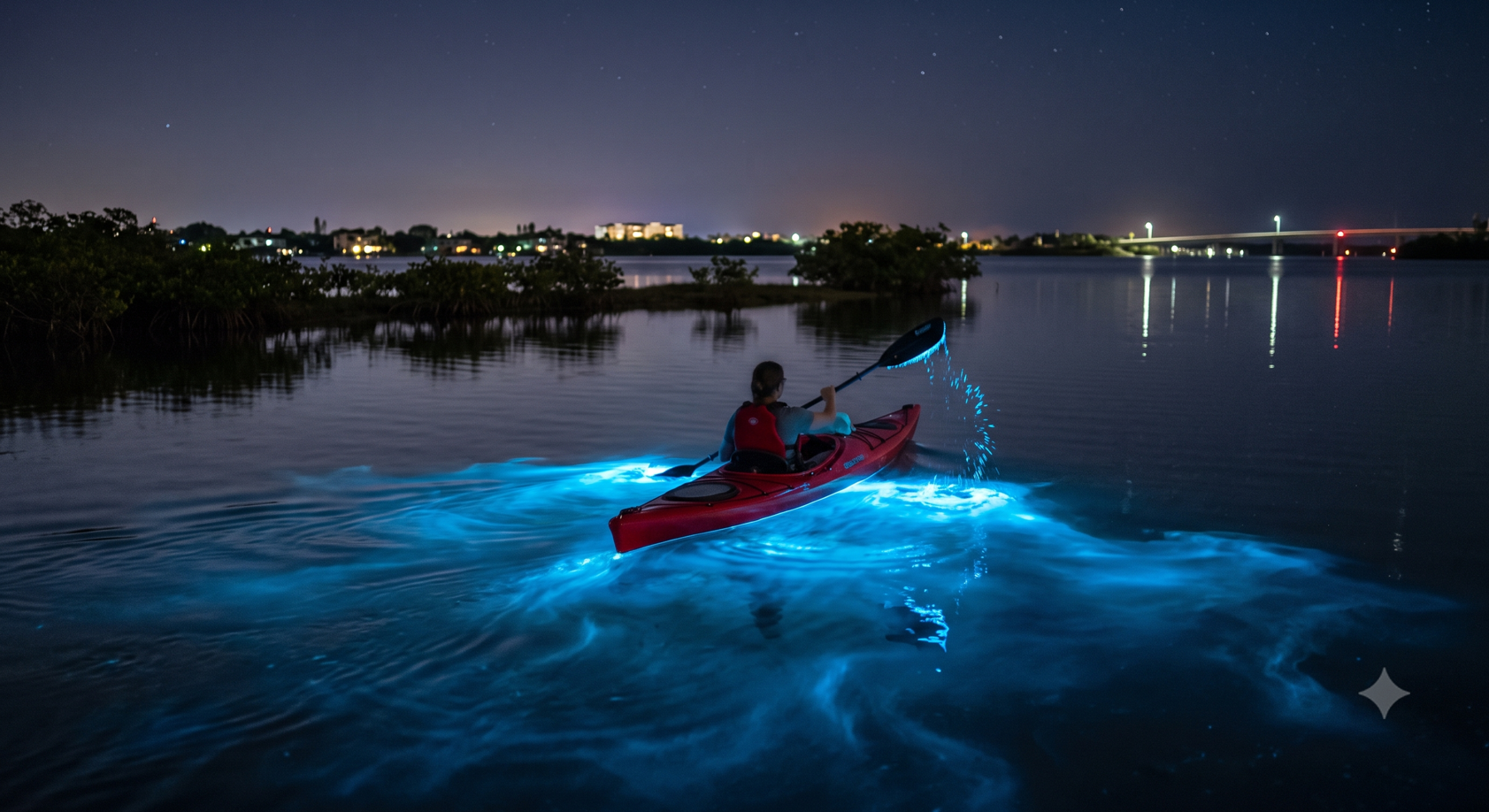
Each summer, the Treasure Coast experiences one of the most extensively studied and visually striking marine phenomena. As water temperatures increase, the Indian River Lagoon transforms into a glowing blue-green spectacle. While the lagoon is integral to local life for residents and visitors, the underlying science reveals a complex microscopic ecosystem responsible for this seasonal illumination.
The Biological Mechanics of the Glow
The neon-blue illumination observed in the lagoon is not caused by moonlight or chemical contamination, but rather by a natural process known as bioluminescence. During the summer months, this phenomenon is primarily driven by a single-celled dinoflagellate species, Pyrodinium bahamense.
The emitted light results from an oxidation reaction within the dinoflagellate cell. Physical disturbances in the water, such as those caused by a passing kayak, a jumping mullet, or tidal changes, mechanically trigger a reaction in which the molecule luciferin reacts with oxygen. The enzyme luciferase catalyzes this process, producing photons of cold light. In contrast to standard lightbulbs, this chemical reaction generates minimal heat, resulting in highly efficient energy transfer.
The "Burglar Alarm" Hypothesis
Marine biologists have extensively investigated the evolutionary reasons for energy expenditure on light production by microscopic organisms. The prevailing scientific explanation is referred to as the "burglar alarm" hypothesis.
When a primary predator, such as a small crustacean, attempts to consume the dinoflagellate, the resulting physical disturbance triggers a flash of light. This illumination startles the primary predator and simultaneously reveals its location to secondary predators, such as small fish. Thus, the dinoflagellate employs bioluminescence to attract larger predators that may consume its initial attacker.
Environmental Triggers: Why Summer?
The vivid bioluminescent displays in the lagoon require high densities of Pyrodinium bahamense, often reaching hundreds of thousands of cells per liter. These population levels depend on specific environmental variables that reach optimal conditions during the summer months:
- Temperature: Pyrodinium bahamense requires warm water and thrives when lagoon temperatures exceed 77°F (25°C).
- Salinity: As an estuary, the Indian River Lagoon features a mix of fresh and saltwater. Pyrodinium bahamense thrives in moderate to high salinity, while heavy and persistent summer rains that significantly reduce salinity can rapidly suppress blooms.
- Nutrient Loads: Elevated nitrogen and phosphorus concentrations in the water column serve as essential nutrients for these microscopic algae. Both natural and artificial runoff contribute to the nutrient availability required for rapid cellular division.
Ongoing Estuary Research
Due to the high sensitivity of bioluminescent dinoflagellates to environmental fluctuations, researchers continuously monitor their populations to assess the overall health of the Indian River Lagoon system. Monitoring the intensity, duration, and spatial distribution of these blooms enables marine biologists to analyze nutrient cycles, salinity variations, and long-term water quality trends.
Residency near the Indian River Lagoon offers not only scenic daytime views but also direct observation of ongoing marine biological processes. Throughout the summer, the lagoon functions as a dynamic, living laboratory, illuminated nightly by the chemical defenses of billions of microscopic organisms.
Check out this article next