




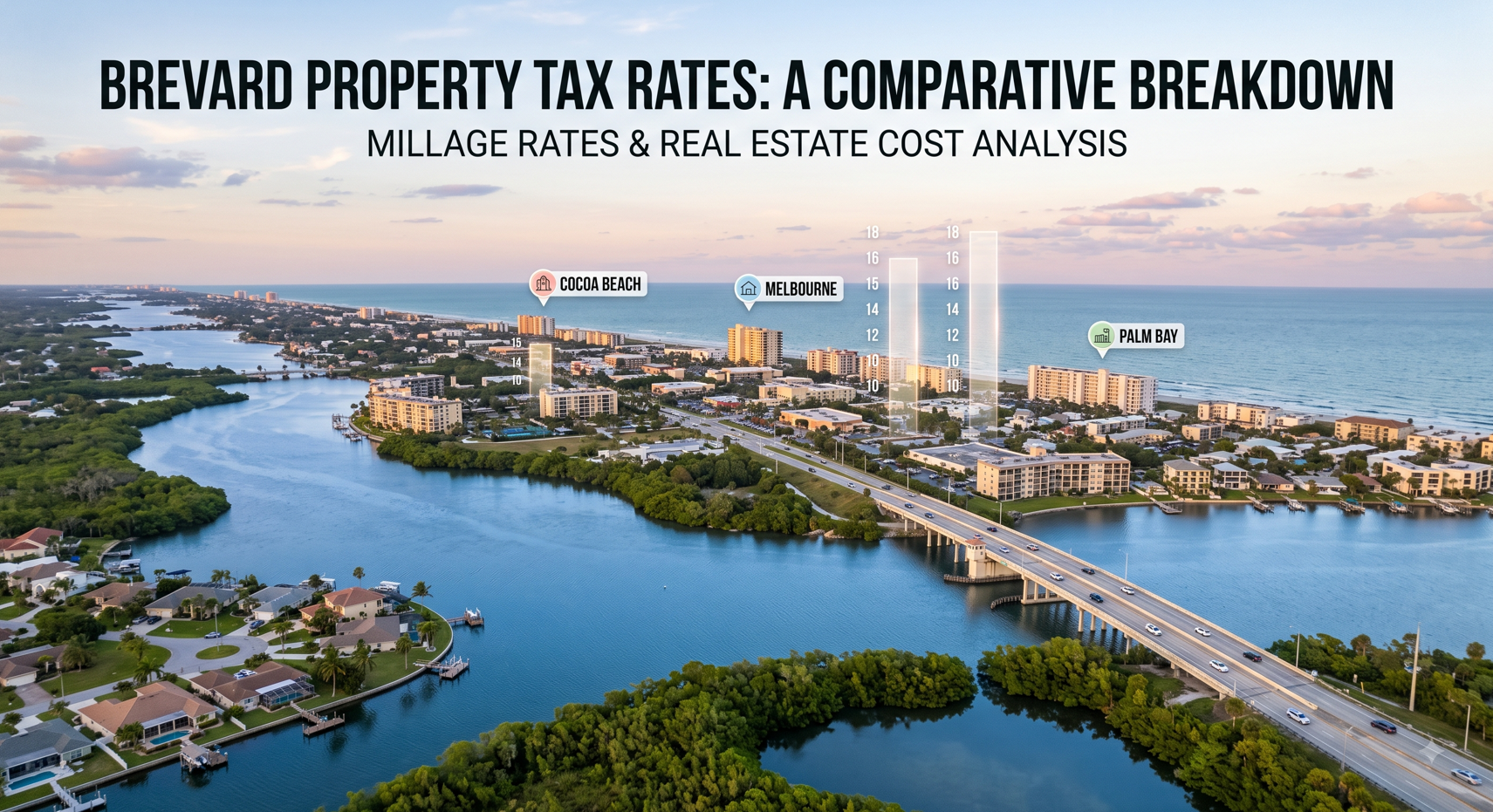
Property taxes across Brevard County’s Space Coast vary significantly. Although all property owners contribute to shared regional services, including the Brevard County School Board, countywide library systems, and mosquito control, the municipal millage rate imposed by individual cities leads to substantial differences in annual carrying costs.
This research report presents a statistical breakdown of property tax millage rates across three Brevard County municipalities: Cocoa Beach, Melbourne, and Palm Bay. Drawing on data from the Brevard County Property Appraiser and municipal budget disclosures, the analysis explores the operation of city-level tax structures, the reasons for rate differences between coastal and mainland sub-markets, and the implications for net ownership costs.
1. Anatomy of a Brevard County Tax Bill
In Florida, a mill represents one dollar of tax liability for every one thousand dollars of taxable assessed property value (1 mill = $1 per $1,000 of taxable value. An ad valorem property tax bill on the Space Coast is a composite of several overlapping taxing authorities, generally divided into four tiers:
- School District Levy (Uniform Countywide): Set by the Brevard County School Board; accounts for approximately 6.31 mills of every tax bill regardless of municipality.
- County Commission General Fund (Uniform Countywide): Funds countywide operations, courts, and regional infrastructure (historically ranging from 2.86 to 3.57 mills).
- Special Districts & MSTUs (Location-Dependent): Independent levies for services such as the Brevard Library District (~0.41 mills), Brevard Mosquito Control (~0.17 mills), and Municipal Service Taxing Units (MSTUs) for fire or law enforcement in areas where the city does not provide dedicated departments.
- Municipal Millage (City Layer): The discretionary ad valorem rate established by city councils to fund local police, fire rescue, road maintenance, and parks.
2. Interactive Millage & Tax Comparison Tool
The interactive visualizer below enables users to model annual property taxes for Cocoa Beach, Melbourne, and Palm Bay by adjusting taxable property values and comparing the impact of municipal millage on total carrying costs.
Analytical Note: Taxable value differs from market value. Under Florida’s Save Our Homes amendment, assessed value growth for homesteaded properties is limited to 3% per year or the change in the Consumer Price Index, whichever is lower. Upon transfer of ownership, the tax cap resets to the current market value for the subsequent tax year.
3. Head-to-Head Municipal Millage Comparison
The following table compares the municipal millage rates for Cocoa Beach, Melbourne, and Palm Bay, as well as the estimated total combined millage, which includes the school board, county general fund, and regional special districts.
Municipality | Municipal Millage Rate (City Layer) | Estimated Non-City Layer (School + County + Special) | Estimated Total Combined Millage | Annual Municipal Tax ($350k Taxable Value) | Annual Total Tax ($350k Taxable Value) |
City of Cocoa Beach | 6.0000 mills | ~9.60 mills | ~15.60 mills | $2,100.00 | $5,460.00 |
City of Melbourne | 7.3089 mills | ~9.65 mills | ~16.96 mills | $2,558.12 | $5,936.00 |
City of Palm Bay | 7.6993 mills | ~9.65 mills | ~17.35 mills | $2,694.76 | $6,072.50 |
Data sources: Brevard County Property Appraiser municipal millage tables and municipal adopted budget figures. Non-city layers represent approximate regional aggregates for comparative modeling.
4. Deep-Dive: Drivers of Municipal Rate Variations
City of Cocoa Beach (6.0000 Municipal Mills)
- The Barrier Island Valuation Effect: Cocoa Beach has the lowest municipal millage among the three cities analyzed (6.0000 mills). Due to higher per-square-foot market valuations for coastal and oceanfront real estate, the city generates substantial ad valorem revenue per parcel despite the lower tax rate.
- Non-Ad Valorem Revenue Offsets: As a primary tourism hub on the Space Coast, Cocoa Beach benefits from substantial non-property tax revenue streams, such as tourist development tax (TDT) allocations, parking enterprise funds, and commercial licensing. These sources help offset the costs of municipal operations and beach preservation.
- Infrastructure Focus: Expenditure priorities center around coastal resilience, stormwater management along the Indian River Lagoon, and public safety scaled for high seasonal visitor density.
City of Melbourne (7.3089 Municipal Mills)
- The Commercial and Residential Core: Melbourne maintains a middle-to-upper municipal millage rate (7.3089 mills). As the economic and healthcare center of southern and central Brevard County, Melbourne offers comprehensive municipal services, including an independent police department, professional fire-rescue facilities, and an extensive municipal water and sewer utility network.
- Balanced Tax Base: Melbourne’s tax base is diversified across high-value commercial corridors, major aerospace and defense employment campuses, and residential subdivisions. This diversification stabilizes the municipal millage rate against fluctuations in the residential market.
City of Palm Bay (7.6993 Total Municipal Mills)
- Residential Density versus Commercial Base: Palm Bay has the highest municipal millage rate among the three cities (7.6993 total municipal mills, including city ad valorem operations and voter-approved general obligation road debt). In contrast to Melbourne and Cocoa Beach, Palm Bay’s property tax base is primarily residential, with a lower proportion of commercial and industrial properties to distribute the overall tax burden.
- Geographic Footprint and Infrastructure Demands: Palm Bay is the largest municipality in Brevard County by both land area and population. Maintaining extensive roadway infrastructure across large residential areas necessitates significant capital investment.
- Voted Debt Levies: Recent municipal budgets include voter-approved General Obligation (G.O.) bonds dedicated to road paving and roadway improvements, which add approximately 1.12 mills in debt service to the baseline operating millage.
5. Incorporated Cities vs. Unincorporated Brevard
A key consideration in Brevard County real estate research is whether a parcel is located within municipal boundaries or in unincorporated Brevard County:
- Unincorporated Pockets (e.g., Suntree, Malabar-adjacent areas, Merritt Island): Properties in unincorporated Brevard pay 0.0000 municipal mills.
- The MSTU Trade-off: However, unincorporated parcels are subject to County Municipal Service Taxing Units (MSTUs) to fund law enforcement (Brevard County Sheriff’s Office) and fire rescue, which adds roughly 1.50 to 2.00 mills back onto the unincorporated tax bill.
- Community Development Districts (CDDs): Master-planned areas like Viera often carry CDD assessments—which appear as non-ad valorem line items on the tax bill to fund infrastructure—meaning a lower millage rate does not always equate to a lower total annual assessment.
6. Research Methodology & Best Practices for Property Evaluation
For residential or commercial acquisitions in Melbourne, Palm Bay, and Cocoa Beach, the Research and Analysis Division at Ocean to River Properties recommends three analytical guidelines:
- Do Not Calculate Future Carrying Costs Based on the Seller’s Current Tax Bill: Due to Florida's Save Our Homes cap, a long-term owner may pay taxes on an assessed value significantly below the property's current market value. The tax bill will reset to the full taxable valuation on January 1 following the year of closing.
- Separate Municipal Millage from County and School Board Rates: When comparing similarly priced properties in different cities, focus on the municipal millage difference. For example, a 1.6993 mill difference between Cocoa Beach and Palm Bay equates to $169.93 per $100,000 of taxable value in annual tax liability.
- Verify Line-Item Special Assessments: Review the non-ad valorem section of the tax roll for location-specific fees, such as stormwater assessments, CDD debt service, and solid waste collection charges.
Check out this article next