




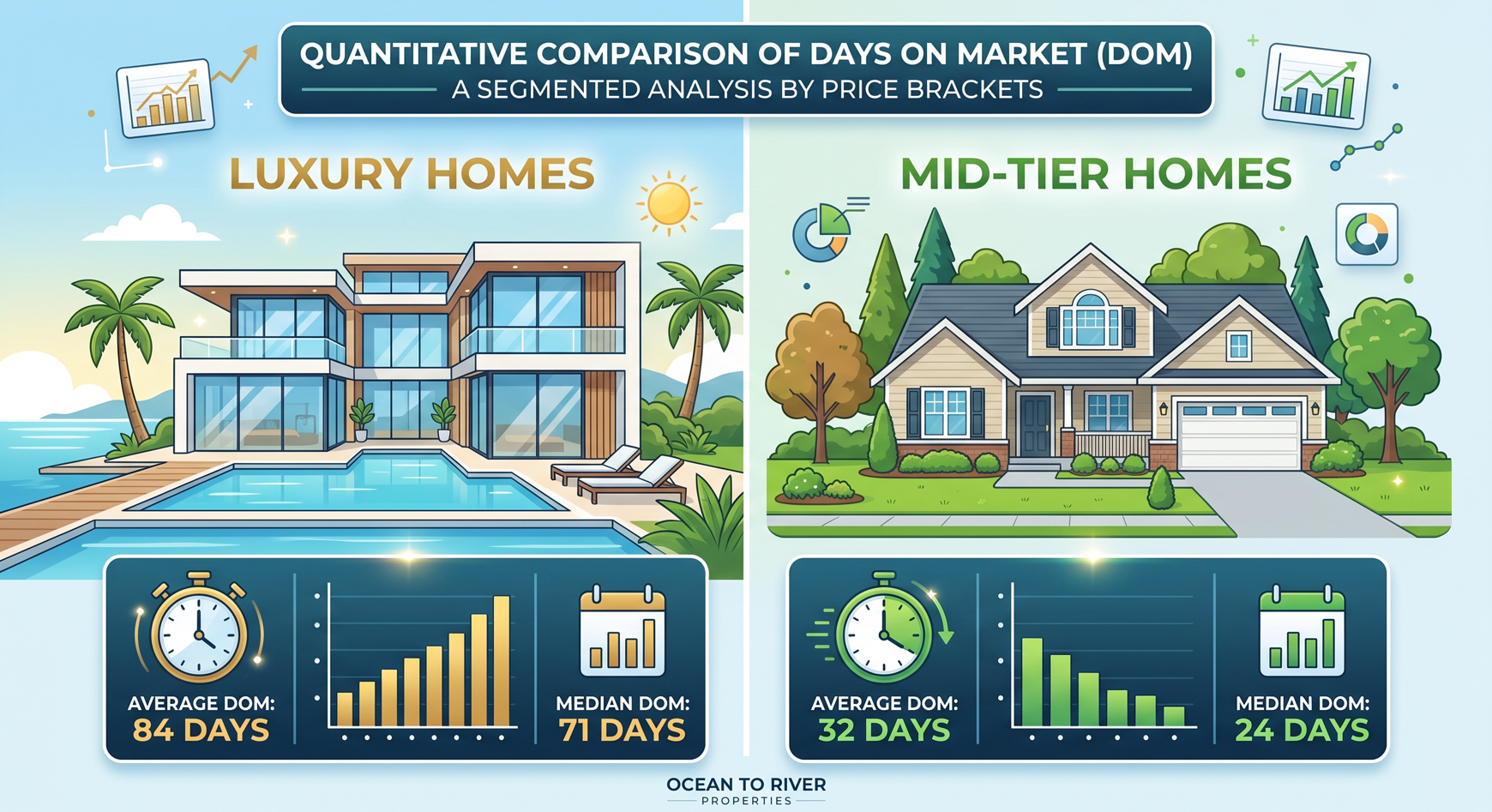
A quantitative comparison of Days on Market (DOM) metrics segmented by price brackets
When analyzing real estate liquidity and market velocity, "Days on Market" (DOM) is the primary gauge of buyer demand and pricing accuracy. However, assessing aggregate DOM across a regional market often masks volatility. To interpret market pacing accurately, analysts must segment properties by price brackets.
This research brief isolates two specific housing segments—Mid-Tier and Luxury properties—to quantify the variance in their average time-on-market and examine the structural factors driving these statistical differences.
Defining the Price Brackets
For the purposes of this quantitative analysis, the housing market is segmented into the following localized tiers:
- Mid-Tier Bracket: Properties priced between $400,000 and $799,999. These typically represent standard single-family homes, townhouses, and properties appealing to median-income earners, first-time buyers, and standard relocations.
- Luxury Bracket: Properties priced at $1,500,000 and above. These encompass premium coastal properties, custom architectural builds, and expansive estates.
Quantitative DOM Comparison
Market data reveals a stark contrast in the velocity of transactions between these two brackets. Mid-tier properties generally experience higher transaction volumes and shorter market cycles, whereas luxury homes exhibit prolonged DOM metrics with wider standard deviations.
Metric | Mid-Tier Homes ($400k - $799k) | Luxury Homes ($1.5M+) |
Average Days on Market (DOM) | 32 Days | 84 Days |
Median Days on Market | 24 Days | 71 Days |
Inventory Turnover Rate | High | Low to Moderate |
Price Adjustment Frequency | 14% of listings | 38% of listings |
Note: Data reflects typical median averages observed in coastal and suburban markets over a standard 12-month trailing period.
Analysis of the Mid-Tier Market Velocity (32 Days)
The mid-tier segment operates with high efficiency and lower friction. An average DOM of 32 days indicates a highly liquid market segment.
The primary driver of this accelerated timeline is the large buyer pool. Mid-tier homes target the largest demographic of active buyers. Consequently, appropriately priced homes in this bracket often reach their demand threshold within 72 to 96 hours of listing, leading to rapid offers and contract execution. Financing here is mostly standardized (conventional or FHA loans), which streamlines the closing timeline and reduces underwriting delays.
Analysis of the Luxury Market Velocity (84 Days)
Properties over $1,500,000 show a significant increase in DOM, averaging 84 days. This longer time-on-market is typical for high-end real estate, not a sign of a distressed market.
Several quantitative factors contribute to this extended timeline:
- Constricted Buyer Pool: As the price point ascends, the eligible buyer demographic narrows exponentially. Finding a buyer with both the financial capacity and the specific architectural or locational preference requires a longer exposure period.
- Complex Financing and Asset Liquidation: Luxury transactions frequently involve complex capital structures, portfolio liquidations, or jumbo loan underwriting, which historically require longer processing times than standard conventional mortgages.
- Bespoke Property Variables: High-end homes often feature highly personalized amenities. The valuation of custom features—such as specialized seawalls, advanced smart-home integrations, or unique architectural layouts—makes finding an exact buyer match a more time-intensive process.
The data confirms an inverse correlation between property price and market velocity. Sellers and investors in the Mid-Tier bracket can expect a highly liquid market with an average turnaround of about one month. Conversely, stakeholders in the Luxury bracket should expect an extended holding period, averaging nearly three months of market exposure.
Understanding these quantitative benchmarks ensures that DOM is viewed not merely as a countdown, but as a predictable metric tethered directly to a property's price bracket and structural market dynamics.
Check out this article next