




For investors analyzing the Florida real estate market, Brevard County’s Space Coast represents a unique convergence of economic drivers. From the booming aerospace sector in the north to the expanding tech and defense corridors in the south, the region offers distinct variables for real estate investment. For clients at Ocean to River Properties, navigating this landscape requires a strict, data-driven approach to evaluating acquisitions.
The fundamental choice for any residential investor in this market is between long-term rentals (LTR) and short-term rentals (STR). This decision changes a property's risk profile, management burden, expense ratio, and overall income potential. This analysis breaks down historical rental yields, capitalization (cap) rates, and economic forces across Space Coast submarkets to provide an objective framework for investment strategy.
The Economic Context of Space Coast Real Estate
Before examining specific yield metrics, it is necessary to contextualize demand. The Space Coast is not a monolithic market; it is segmented by localized economic catalysts.
In the northern and central areas, the resurgence of the Kennedy Space Center and rapid expansion of private aerospace companies have created a massive influx of skilled, transient, and permanent contractors. To the south, major defense and technology employers provide a stable, long-term workforce. Meanwhile, the coastal barrier islands, anchored by Cocoa Beach and Port Canaveral, drive a robust tourism and cruise-industry economy. These distinct renter pools directly dictate the viability of LTR and STR strategies across zip codes.
Long-Term Rental Capitalization Rates: Stability and Workforce Demand
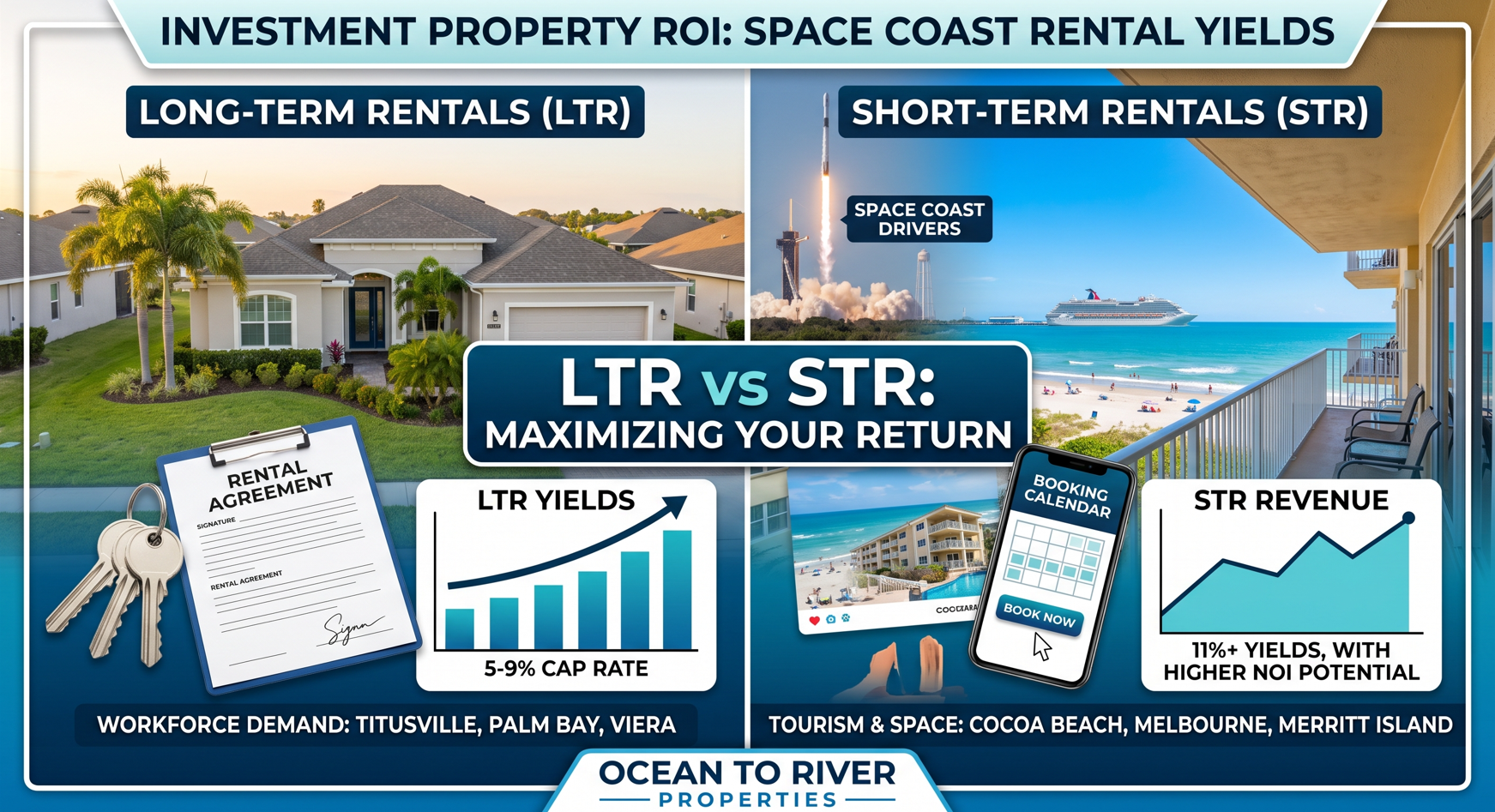
For long-term buy-and-hold strategies, Brevard County yields range broadly from 5.0% to 9.0%, heavily dependent on the specific municipality and neighborhood asset class. The LTR model is primarily driven by consistent workforce demand and steady demographic growth.
- Titusville: Historically, this submarket has produced Brevard County's highest capitalization rates. This is largely due to lower acquisition costs relative to achievable market rents. Driven by the continuous demand from aerospace contractors and support staff, LTR cap rates in Titusville consistently target the 7.0% to 9.0% range.
- Palm Bay: As the most populous city in the county, Palm Bay provides workforce demand for single-family homes. The area attracts families and professionals commuting to major local employers. Investors typically observe LTR cap rates between 6.5% and 8.0% in this submarket. Standard three-bedroom, two-bathroom single-family homes command between $1,750 and $2,100 in monthly rent, providing predictable cash flow with low tenant turnover.
- Viera: Investors focusing on Viera, a highly sought-after master-planned community, often prioritize long-term asset appreciation over immediate cash yield. Because property acquisition costs are significantly higher, cap rates for long-term rentals here are generally compressed, typically hovering between 5.0% and 6.0%. The tradeoff is historically lower vacancy rates, premium tenant profiles, and reduced capital expenditure requirements on newer builds.
Short-Term Rental Yields: High Revenue vs. High Expense Profiles
Short-term rentals can substantially outperform long-term properties in gross income, but the expense structure differs dramatically. Analyzing STRs requires rigorous evaluation of net operating income (NOI) rather than top-line revenue, as operational friction is higher.
- Cocoa Beach: Cocoa Beach is the most prominent STR market in the area, buoyed by year-round launch-related tourism, snowbirds, and direct beach access. Well-located properties can generate $45,000 to over $80,000 in gross annual revenue. However, NOI usually ranges between $20,000 and $40,000. This compression results from significant expenses, including intensive property management, frequent maintenance, turnover cleaning, and elevated insurance premiums for coastal assets costing $8,000 to $14,000 annually.
- Melbourne and Merritt Island: Moving away from the direct beachfront but maintaining coastal proximity, areas like Melbourne and Merritt Island offer varied STR opportunities. A well-located three-bedroom property in Melbourne can gross $40,000 to $60,000 annually with active management, assuming a 65% to 78% occupancy rate. In research case studies, Merritt Island STRs have shown cap rates up to 11.8%, outpacing regional residential benchmarks, though this requires aggressive revenue management and strong localized marketing.
Comparative Analysis: LTR vs. STR Performance Metrics
When analyzing similar assets side-by-side, the divergence between net and gross income becomes the defining factor in the LTR versus STR debate.
Revenue vs. Expense Ratios While a Space Coast STR might gross significantly more than an equivalent LTR, structural operating costs heavily reduce that margin. Short-term management fees (often 20% to 25% of gross revenue), cleaning, platform commissions, commercial utility usage, and rapid wear-and-tear reduce net income. For example, a detailed investment analysis on a Merritt Island property showed STR operating costs reaching $25,772 annually, compared to just $10,324 for a comparable LTR. Investors must calculate whether the spread in net income justifies the added operational complexity.
Risk Factors and Regulatory Environments LTRs provide steadier occupancy, predictable lease terms, and vastly lower regulatory risk. STR investors, conversely, face a dynamic set of variables. They must rigorously confirm specific municipal zoning rules, as several Space Coast cities have strict ordinances regarding minimum stay lengths and licensing requirements. Furthermore, verifying HOA restrictions is critical, as community bylaws frequently supersede city zoning. Additionally, potential local STR regulation changes and Florida's volatile property insurance market remain ongoing risks that must be accurately modeled during the acquisition phase.
Maximizing investment property ROI on the Space Coast requires aligning an asset's location with the right rental strategy and conducting strict financial due diligence. For investors prioritizing stable, passive income and lower operational overhead, the LTR markets in Palm Bay and Titusville offer solid returns driven by workforce expansion. For those willing to treat their property as an active hospitality business to chase higher yields, the STR markets in Cocoa Beach, Merritt Island, and Melbourne present lucrative opportunities.
Thorough research, localized market knowledge, and conservative expense modeling are paramount to navigating the varying capitalization rates across Brevard County successfully.
Check out this article next