




In real estate economics, few metrics are scrutinized as closely as the Federal Reserve’s benchmark interest rates. For coastal and aerospace-driven markets like Brevard County, understanding the macroeconomic levers influencing local microeconomics is essential for investors, buyers, and sellers.
At Ocean to River Properties, our approach is rooted in data and research. This analysis examines the historical correlation between Federal Reserve interest rate cycles, shifts in local purchasing power, and effects on real estate transaction volumes across the Space Coast.
The Mechanism: Federal Reserve Data and Purchasing Power
While the Federal Reserve does not set mortgage rates directly, the federal funds rate influences the 10-year Treasury yield, the benchmark for 30-year fixed mortgage rates. Historically, the inverse relationship between interest rates and purchasing power is a fundamental rule of real estate economics.
A standard macroeconomic baseline suggests that for every 1% increase in interest rates, a buyer's purchasing power decreases by approximately 9% to 11%.
For a buyer in Brevard County looking at a median-priced home, a shift from 5% to 7% interest rates fundamentally alters debt-to-income (DTI) ratios. To keep the same monthly principal and interest payment, the buyer must either increase their down payment or target a property priced about 20% lower. This erosion of purchasing power is the primary catalyst for shifts in transaction volumes.
Historical Correlations: Rates vs. Brevard Transaction Volumes
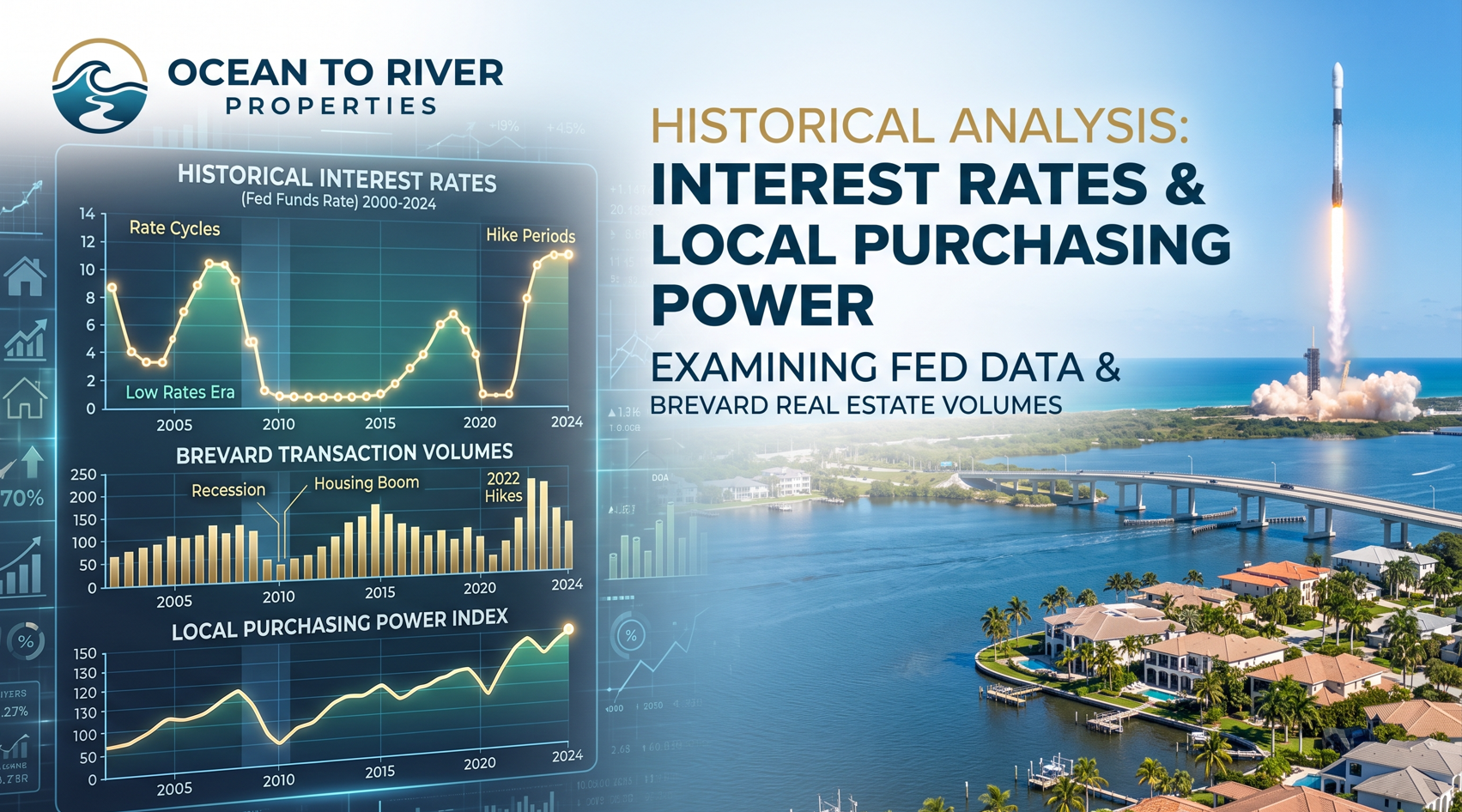
When analyzing decades of transaction data in Brevard County spanning the early 2000s expansion, the 2008 contraction, the 2018 rate hikes, and the post-2022 tightening cycle, distinct patterns emerge in how transaction volumes react to Federal Reserve policy.
1. The "Lock-In" Effect and Inventory Compression
Historically, rapid increases in the federal funds rate lead to a swift decline in transaction volumes. This decline is not only due to reduced buyer demand but also a supply constraint known as the "mortgage rate lock-in effect."
Data shows that when current market rates exceed a homeowner's existing mortgage rate by more than 1.5% to 2%, discretionary selling plummets. Homeowners in areas like Viera, Melbourne, and the beaches hold their assets rather than trade up and assume higher capital costs. Consequently, transaction volumes drop not only because buyers cannot afford homes but also because inventory naturally constricts.
2. The Brevard Anomaly: Employment as a Floor
While national transaction volumes often show a 1:1 correlation with drastic rate hikes, historical data reveals Brevard County has a unique buffer. The Space Coast’s reliance on aerospace, defense, and STEM sectors, driven by expansions at NASA, SpaceX, Blue Origin, and L3Harris, creates an inelastic floor for housing demand.
During the Fed's aggressive tightening cycles (such as 2022-2023), national existing-home sales experienced steep double-digit declines. However, Brevard County's transaction volumes, while softened, historically show a shallower trough. Inbound migration tied to high-paying aerospace contracts offsets some purchasing power loss from higher rates, sustaining transaction activity that outpaces non-coastal, non-tech-driven tertiary markets.
3. Rate Plateaus and Volume Resurgence
Historical research indicates that transaction volumes do not require rock-bottom interest rates to recover; they simply require stabilization. When the Federal Reserve signals an end to rate hikes and maintains a plateau, market psychology shifts.
Historical data from the late 1990s and late 2010s shows that once rates remain stable for two to three consecutive quarters, buyers recalibrate expectations and accept the "new normal." Wage growth during this period gradually restores some lost purchasing power, and transaction volumes in Brevard begin to normalize and rise, even if rates remain elevated compared to previous decades.
Data-Driven Conclusions for the Current Market
Synthesizing historical Federal Reserve data with Brevard County’s specific market metrics provides a clear, research-backed framework for current market expectations:
- Purchasing Power: Buyers in the current market must rely on increased equity from previous sales or adjust geographic and property-type parameters to accommodate higher borrowing costs.
- Transaction Volume Outlook: Based on historical models, as the Federal Reserve navigates current stabilization or easing cycles, transaction volumes will follow a lagging upward curve. As the gap between existing "locked-in" rates and current market rates narrows, inventory will slowly unlock.
- The Space Coast Premium: The localized influx of capital and high-income employment in the aerospace sector will continue to buoy transaction volumes in Brevard County, preventing the severe volume contractions seen in broader national datasets.
At Ocean to River Properties, we rely on empirical data and historical market analysis to navigate changing economic tides. Understanding how macroeconomic policy directly dictates local purchasing power and transaction fluidity is critical to executing a successful, data-driven real estate strategy.
Disclaimer: This article is for informational and research purposes only and does not constitute financial, investment, or legal advice. Real estate markets are subject to macroeconomic fluctuations.
Check out this article next