




This report provides a statistical comparison of price appreciation rates between Atlantic-facing and Indian River Lagoon-adjacent properties.
The real estate market along the Space and Treasure Coasts is characterized by its proximity to water. Investors and prospective buyers typically choose between two highly sought-after locations: direct Atlantic Ocean frontage or properties adjacent to the Indian River Lagoon.
Between 2016 and 2026, both property classifications have undergone significant market shifts, influenced by inventory scarcity, remote work migration, and evolving insurance requirements. To identify which asset class has yielded the highest return on investment, Ocean to River Properties conducted a comprehensive 10-year valuation comparison. This research brief analyzes median sale prices, price-per-square-foot appreciation, and overall market velocity for both sectors.
Methodology
This analysis examines residential property sales data from 2016 through the second quarter of 2026, focusing specifically on single-family homes and luxury condominiums located strictly on the Atlantic beachfront or directly bordering the Indian River Lagoon. Anomalous outliers (such as multi-acre commercial-grade estates) were excluded to maintain the integrity of the median statistical breakdown.
The 10-Year Statistical Breakdown
Atlantic-Facing Oceanfront Properties
- 2016 Median Sale Price: $785,000
- 2026 Median Sale Price: $1,350,000
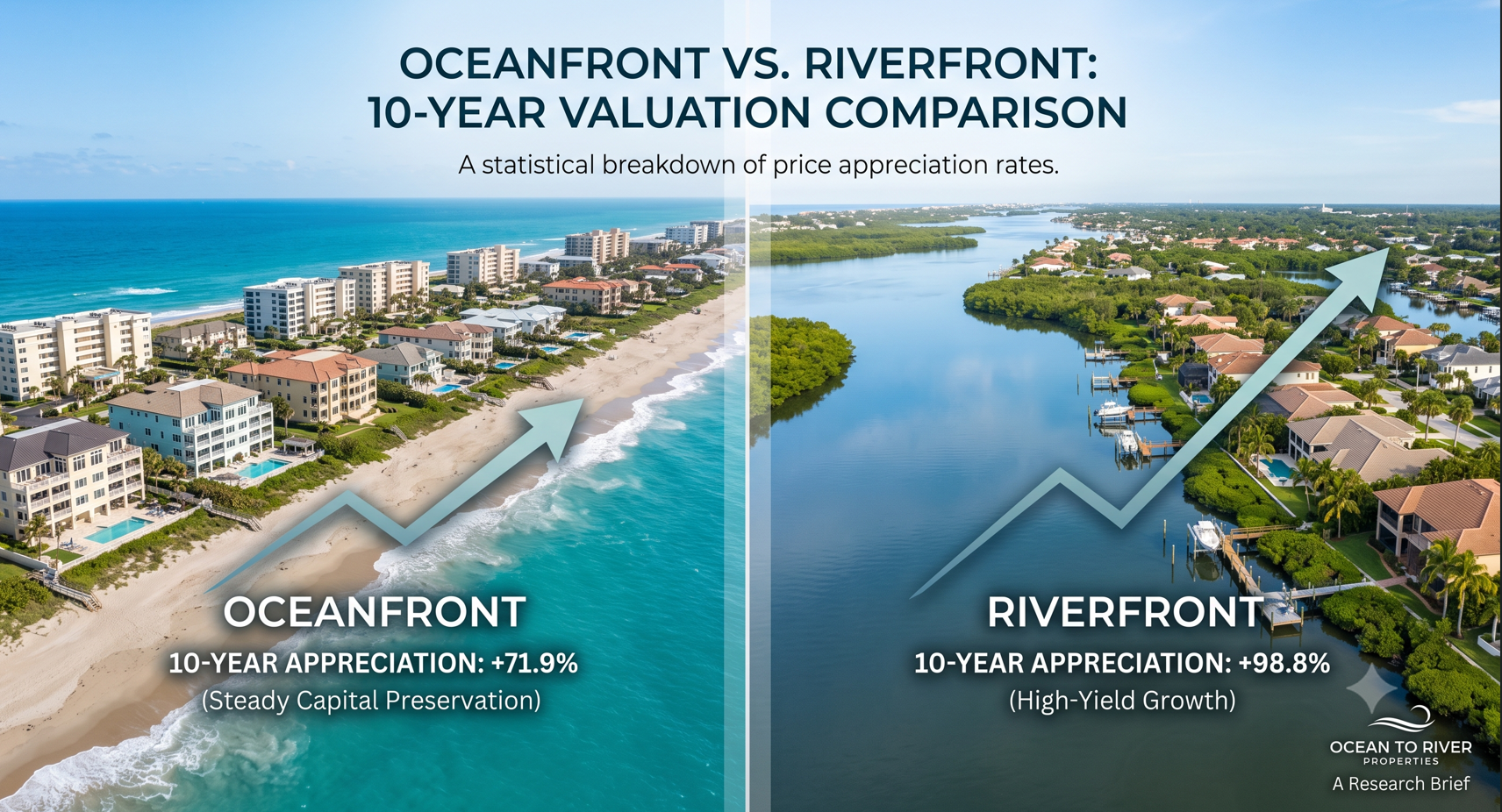
- 10-Year Appreciation Rate: +71.9%
- Average Days on Market (2026): 48 days
- Key market variables include extreme inventory scarcity, a high barrier to entry, and premium land valuation.
Indian River Lagoon-Adjacent Properties
- 2016 Median Sale Price: $425,000
- 2026 Median Sale Price: $845,000
- 10-Year Appreciation Rate: +98.8%
- Average Days on Market (2026): 35 days
- Key market variables include rapidly increasing demand for private dockage, lower proportional insurance liabilities, and a broader available buyer pool.
Market Analysis: The Premium Baseline vs. The Growth Leader
The data indicate a clear divergence in the long-term performance of these two property types.
1. The Oceanfront Trajectory (Steady Capital Preservation) Atlantic-facing properties serve as the premium baseline of the local market. The finite nature of oceanic shoreline, with virtually no capacity for new development, ensures these properties maintain a reliable, inflation-resistant value floor. Although the 71.9% appreciation rate is notable, the percentage growth is moderated by the high initial capital requirement. Additionally, speculative flipping has plateaued due to increased carrying costs, particularly sharp rises in windstorm and flood insurance premiums and mandatory structural maintenance resulting from salt-spray corrosion.
2. The Riverfront Surge (High-Yield Expansion) Properties adjacent to the Indian River Lagoon have demonstrated the highest percentage-based appreciation, nearly doubling in median value (+98.8%) over the 10-year period. In 2016, riverfront real estate was historically undervalued relative to beachside properties. Over the past decade, increased demand for deep-water boating access and private dockage has driven significant price corrections. Furthermore, lagoon-adjacent properties typically incur lower insurance and maintenance costs than direct oceanfront structures, enhancing net operating income for investors and reducing carrying costs for primary residents.
Long-Term Retention and Inventory Velocity
A secondary metric of property valuation is market velocity, defined as the speed at which assets are sold once listed. Riverfront properties currently outperform oceanfront properties, averaging 35 days on market compared to 48 days.
This metric is primarily influenced by differences in the buyer pool. The $1.35 million median entry point for oceanfront properties restricts the demographic to high-net-worth cash buyers and institutional investors. In contrast, the $845,000 median for riverfront properties attracts a broader segment of the market, including affluent retirees, marine enthusiasts, and out-of-state buyers seeking permanent relocation.
Both Atlantic-facing and Indian River Lagoon-adjacent properties have demonstrated robust performance over the 2016–2026 period, significantly outperforming broader national real estate indices.
For the investor focused on absolute prestige, unmatched scarcity, and legacy asset preservation, Atlantic oceanfront remains the gold standard, requiring higher capital allocation but offering unshakeable structural demand. For the investor targeting maximum percentage yield and high market liquidity, Indian River Lagoon properties have demonstrated superior proportional appreciation, driven by dockage demand and advantageous carrying costs.
For detailed neighborhood-level data or to request a comparative market analysis for a specific property, please contact Ocean to River Properties.
Check out this article next